


Most quality issues don’t fail overnight — they drift quietly until it’s too late to ignore.
Quality in care has always mattered. But the way it is judged has changed.
Today, when a family member, professional, regulator or commissioner asks about the quality of your service, reassurance on its own is no longer enough.
Good intentions matter. Compassion matters. Experience matters.
But increasingly, leaders are being asked a different question:
Can you show it?
That shift is one of the biggest pressures facing care leaders today.
The real challenge is not scrutiny. It is scrutiny without facts.
In care, many difficult conversations start with opinion.
- A resident seems more unsettled.
- A family feels something has changed.
- A professional says the home is calling too often.
None of those concerns should be ignored.
But without evidence, quality conversations can become defensive very quickly.
Leaders end up trying to protect their service rather than improve it.
That is where the real problem starts.
Because quality rarely fails overnight.
It usually drifts.
And unless you can spot the signals early, you only act once the issue has already become bigger than it needed to be.
A mindset shift that changes the conversation
One of the most useful shifts we have made in our own homes is this:
Instead of asking:
“Is our care good?”
We now ask:
“What signals would tell us if something was starting to drift?”
That question changes everything.
It moves quality from:
- opinion to evidence
- reaction to prevention
- defensiveness to improvement
It helps leaders look for patterns early and take action calmly.
A real example
A few years ago, one of our homes received feedback from a GP practice saying we were calling too often.
If I am honest, the first reaction was defensive.
The instinct was:
“We only call when we need to.”
But instead of turning it into an argument, we stepped back and looked at the evidence.
We reviewed:
- how often calls were being made
- what those calls were about
- how long they lasted
- whether there were better ways to structure communication
What we found was helpful for both sides.
- Some calls were absolutely appropriate.
- Some could have been grouped together.
- Some issues did not need an immediate call and could be picked up in a more structured way.
That one conversation changed more than we expected.
- It improved the relationship with the GP practice.
- It created a more consistent communication process.
- And ultimately, it improved the quality of care because everyone was working with greater clarity.
The lesson was simple:
The goal was not to win the argument. The goal was to improve the conversation.
What good quality leadership actually looks like
Good quality leadership is not about drowning in dashboards.
It is about knowing what to pay attention to.
In our experience, three areas matter most:
Responsiveness
How quickly and consistently are people getting the support they need?
Experience
What does care actually feel like for residents, families, staff and visiting professionals?
Stability
Are things improving, holding steady, or starting to drift?
That is where evidence becomes useful.
Not as admin.
Not as a burden.
But as a way of helping leaders make clearer decisions and take teams with them.
Because more data does not automatically mean better care.
Better leadership does.
And good leaders use evidence to:
- ask better questions
- understand trends
- reduce unnecessary pressure
- and build confidence in the decisions they make
Start smaller than you think
One trap in care is believing that a stronger quality culture means measuring everything.
It does not.
A better place to start is this:
- Pick a few areas that most affect resident experience
- Track them consistently
- Review patterns, not one-off incidents
- Ask why, not who
- Use what you learn to make one improvement at a time
That is how quality becomes something you lead proactively, rather than defend reactively.
Want to go deeper?
This kind of leadership does not happen by accident.
It comes from:
- having the right frameworks
- learning from others facing similar scrutiny
- and having the support to turn evidence into confident action
That is exactly what we focus on inside the Care Home DigiHive.
Through:
- practical courses
- mentoring-style sessions
- coaching and shared learning
- and a community of care home leaders
we help providers strengthen decision-making across quality, profit, time and people.
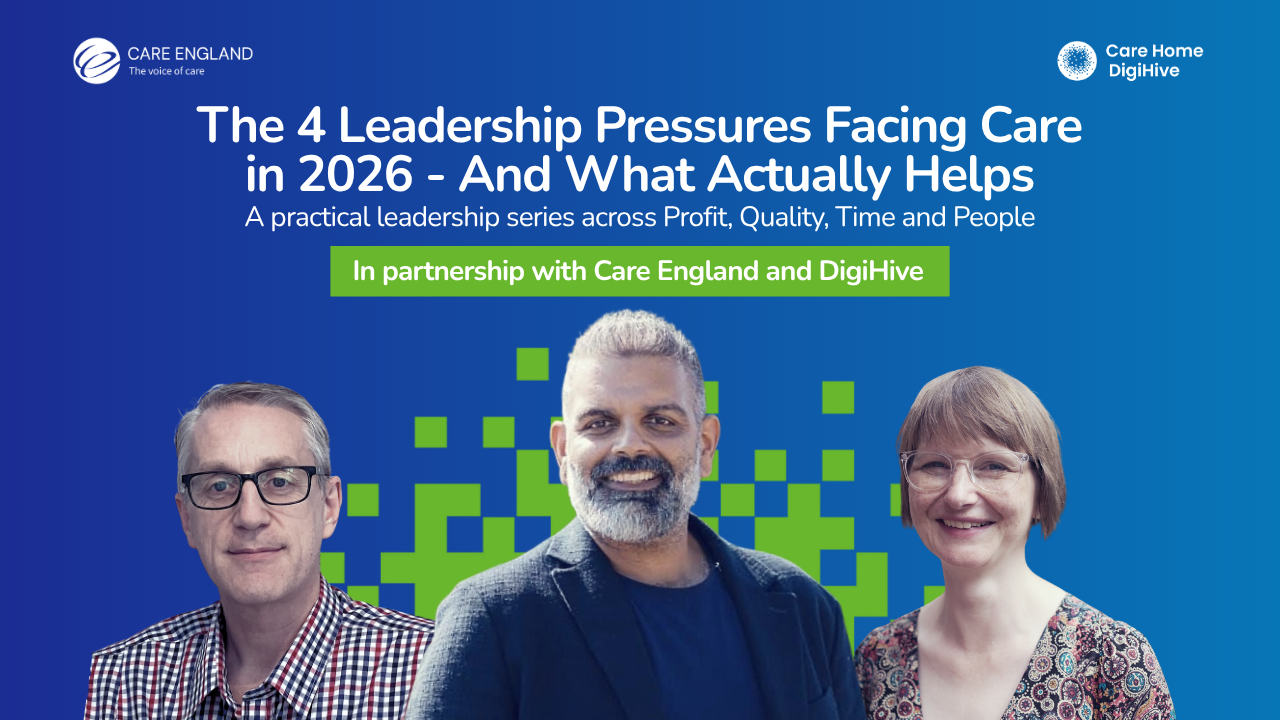
As part of our partnership with Care England, we’ve explored this in more depth in a dedicated leadership session on quality, including:
- why reassurance is no longer enough
- how to spot quality drift early
- and how to use evidence without creating more pressure
Watch the full podcast:

Over the coming weeks, we’ll be sharing further insights across the four key leadership areas: Profit, Quality, Time and People
All grounded in real care home leadership — not theory.
Samir, Founder – Care Home DigiHive
For further information about DigiHive, go to: DigiHive x Care England

Comments
Login/Register to leave a comment