


Why profit isn’t a dirty word in social care – and why hesitation is costing providers more than they think
In a sector where compassion rightly takes centre stage, “profit” has often been treated as an uncomfortable term. But in a new podcast series from Care England and DigiHive, that narrative is being challenged head-on.
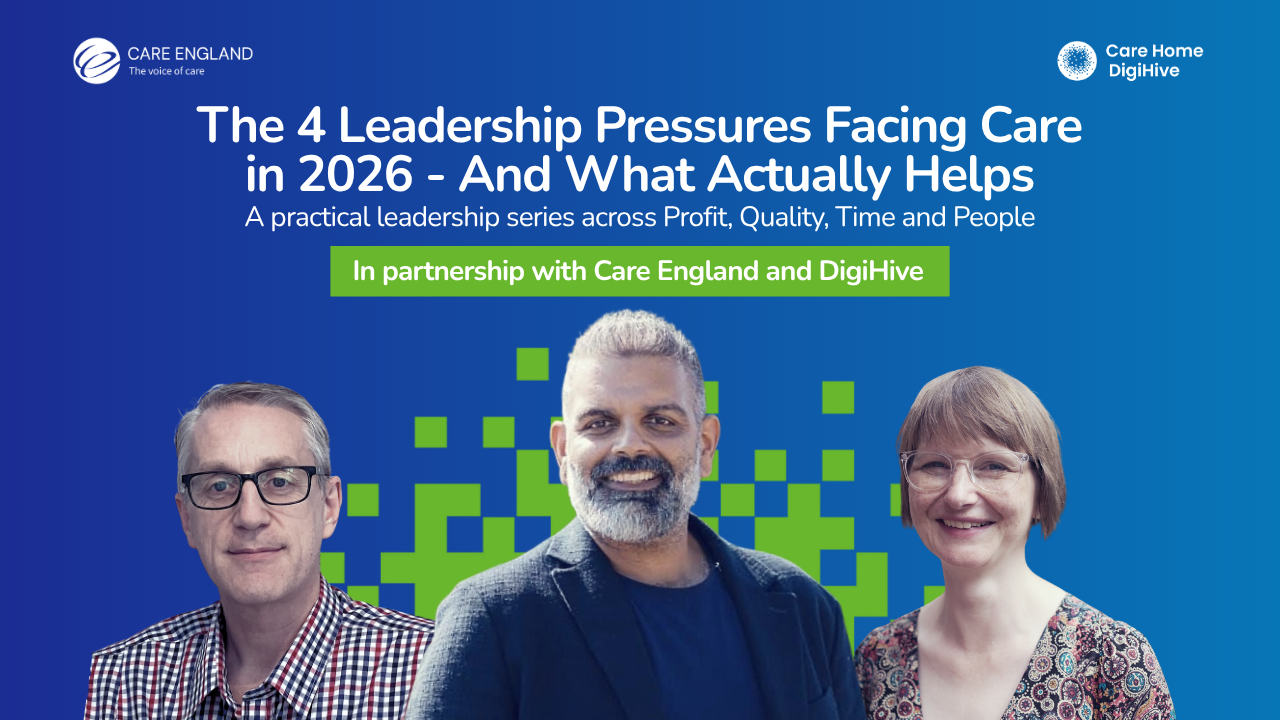
In this opening episode, Care England’s Social Care Adviser Richard Ayres and DigiHive’s Samir Patel explore one of the most pressing issues facing providers today: financial sustainability, and why the real risk isn’t spending, but standing still.
From the outset, the conversation reflects what most providers already feel. Margins are tight, costs are rising, and every decision carries weight. Staffing, energy, compliance, the pressures are relentless. But as Samir makes clear, these challenges are not imagined or exaggerated; they are the lived reality of running services today.
What emerges quickly is a powerful reframing. Profit, Samir argues, is not about excess, it is about survival and reinvestment. Without it, providers simply cannot sustain or improve the care they deliver. This is not about luxury; it is about maintaining quality and ensuring long-term viability.
Yet despite this, many leaders find themselves stuck. Not because they are reckless, quite the opposite. The podcast highlights a key tension: leaders in social care are deeply cautious, often delaying decisions to avoid risk. But that hesitation, while understandable, can quietly erode progress.
One of the most striking insights from the discussion is that financial challenges are often not caused by poor decisions, but by delayed ones. In a sector that cannot afford to “fail fast” like the tech world, the instinct is to wait for certainty. But certainty rarely comes.
Instead, the conversation encourages a shift in mindset: from asking “Can we afford this?” to “What is the cost of doing nothing?”
This is brought to life through a practical example. Samir shares how a relatively modest investment, around £200 per month in a CRM system, transformed occupancy across his services. By improving follow-up processes and visibility of enquiries, occupancy increased significantly, while void periods reduced. The lesson is simple but powerful: not all impactful change is complex or expensive, but it does require action.
The podcast also moves beyond tools and technology to focus on leadership. Good data, the speakers argue, only matters if it drives decisions. And leadership in today’s care environment is no longer about maintaining the status quo, it is about navigating constant change, often while “firefighting” competing priorities.
So what should providers do?
The advice is refreshingly practical. Start small. Focus on one decision that has been repeatedly delayed. Define the real problem, not just the symptom. And crucially, make a conscious choice, whether that is to act now or deliberately defer.
Because in the end, progress in social care is not driven by perfect strategies or new systems alone. It comes from confident, timely decisions made in the reality of day-to-day leadership.
This podcast doesn’t offer theory. It offers something far more valuable: honest reflection, grounded experience, and a clear message that doing nothing is still a decision.
Watch the full podcast:

For further information about DigiHive, go to: DigiHive x Care England
Comments
Login/Register to leave a comment