

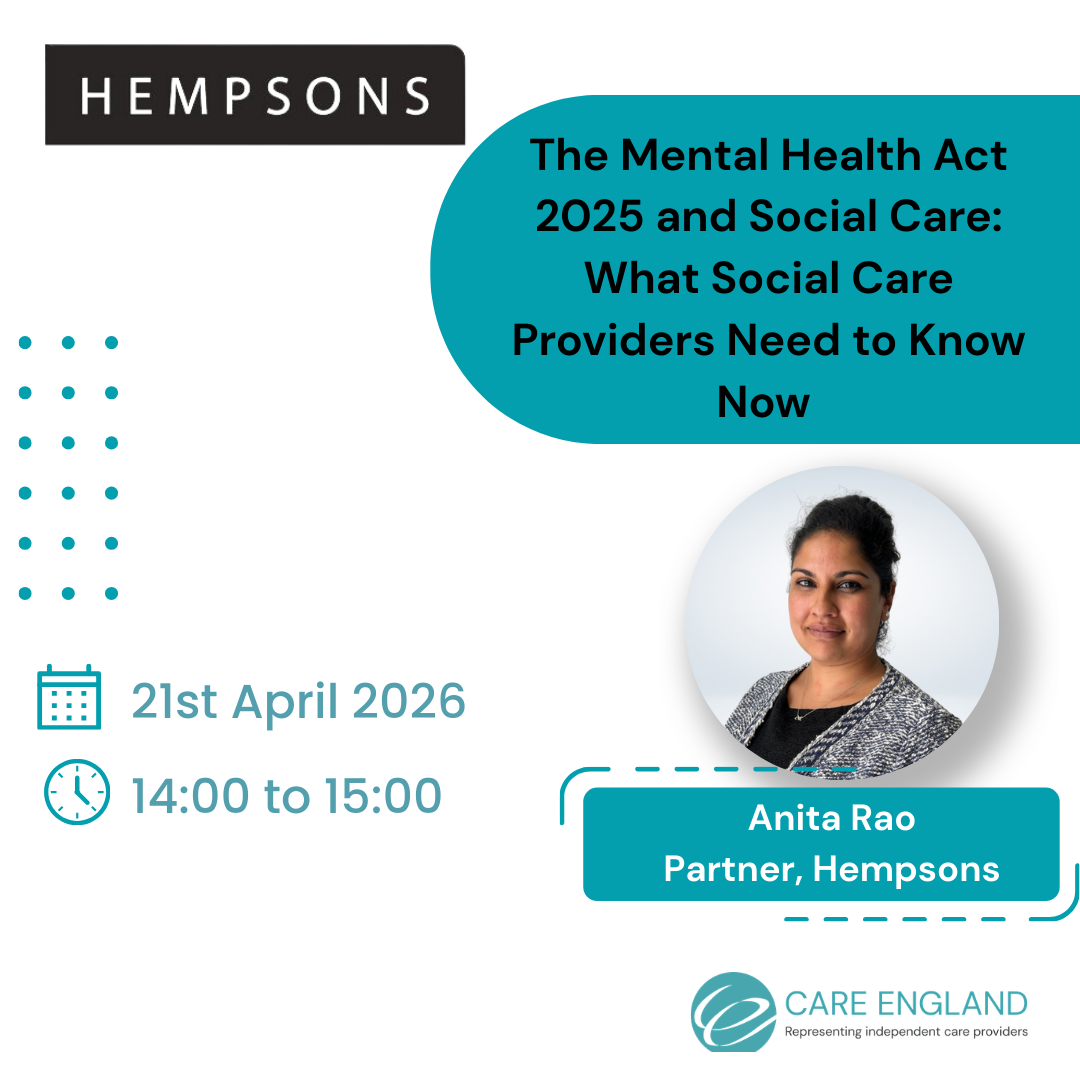
A recording of the webinar can reviewed below, and a copy of the slides can be found HERE.
The biggest reform to mental health law in over 40 years is underway.
Are you ready for what it means in practice?
The Mental Health Act 2025 is not a technical update. It is a structural shift in how mental health law will operate across England and Wales and social care will feel the impact.
With Royal Assent granted in December 2025 and phased implementation beginning, the direction of travel is now clear:
- Fewer hospital detentions
- Greater complexity of need in the community
- Stronger legal duties around care planning
- Increased emphasis on autonomy and advance decision-making
- A more assertive, rights-based framework
For adult social care providers, this is not distant policy. It is a strategic and operational issue that requires early preparation.
Participants joined Anita Rao, Partner at Hempsons LLP, and Rosie Harding, Solicitor at Hempsons, for a practical, no-nonsense webinar and live Q&A exploring what the Act would mean for their organisation and what they should be thinking about.
Why This Matters to Social Care
The reforms are designed to modernise mental health law and align it more closely with human rights and the Mental Capacity Act. But in doing so, they are expected to shift more responsibility into community settings.
That means:
Increasing complexity in community services
The new detention threshold raises the bar for hospital admission. In practice, more individuals with significant mental health needs, including those with learning disabilities and autism are likely to be supported in community settings.
Providers must begin asking:
- Are we equipped to support higher acuity mental health presentations?
- Do we have the right training and workforce capability?
- Are our relationships with community mental health teams strong enough?
Care and Treatment Plans become a legal duty
For the first time, care and treatment plans will sit on a statutory footing for individuals under Community Treatment Orders (CTOs), guardianship, and certain other arrangements.
CQC will not view this as optional.
Providers will need to demonstrate:
- That they know which individuals are under a CTO or s117 aftercare
- That care and treatment plans are held locally
- That those plans actively inform day-to-day support
- That communication with Responsible Clinicians and CMHTs is robust
This moves care planning from “good practice” to legal expectation.
Advance Decisions move from theory to operational reality
The Act significantly strengthens the role of advance decision-making.
For providers, this raises important questions:
- Are we routinely discussing future mental health treatment wishes?
- Do staff feel confident initiating these conversations?
- How does this integrate with our existing “planning for the future” approach?
Person-centred care is no longer just cultural, it is becoming more explicitly statutory.
What the Webinar Covered
In this session, Anita:
- Provided a clear overview of what the Act was designed to achieve
- Explained the four new underpinning principles shaping decision-making
- Outlined which provisions were coming into force first
- Identified the areas most likely to affect adult social care
- Highlighted where CQC scrutiny was likely to intensify
- Shared practical steps providers could take to prepare
- Answered live questions
This was not theoretical analysis. It was grounded in the operational realities providers were already facing.
Who Attended
This webinar was essential for:
- Provider CEOs and senior leaders
- Registered Managers
- Governance and compliance leads
- Workforce development leads
- Commissioners and system partners
If an organisation supported individuals with mental health needs, learning disabilities or autism, particularly in supported living, residential care or complex community settings, this session was directly relevant.
The Road Ahead
While much of the Act would be phased in over time, the strategic direction had been set.
The sector had a window of opportunity to prepare:
- Strengthen workforce capability
- Deepen partnerships with mental health services
- Review care planning processes
- Embed proactive advance decision discussions
- Align governance frameworks with the evolving legal landscape
Providers who started thinking about this early were in a far stronger position as implementation accelerated.
Should you wish to discuss any of the points raised or have further questions, please contact:
Anita Rao – Partner, Hempsons: A.Rao@hempsons.co.uk
Rosie Harding – Solicitor, Hempsons: R.harding@hempsons.co.uk
“Please note that this webinar was recorded before the judgement in the case of A Reference by the Attorney General for Northern Ireland of a devolution issue under paragraph 34 of Schedule 10 to the Northern Ireland Act 1998 [2026] UKSC 16 which came out on 2 June 2026 and amended the criteria for a deprivation of liberty. Users should check the most up to date position in relation to this area.”


Comments
Login/Register to leave a comment