

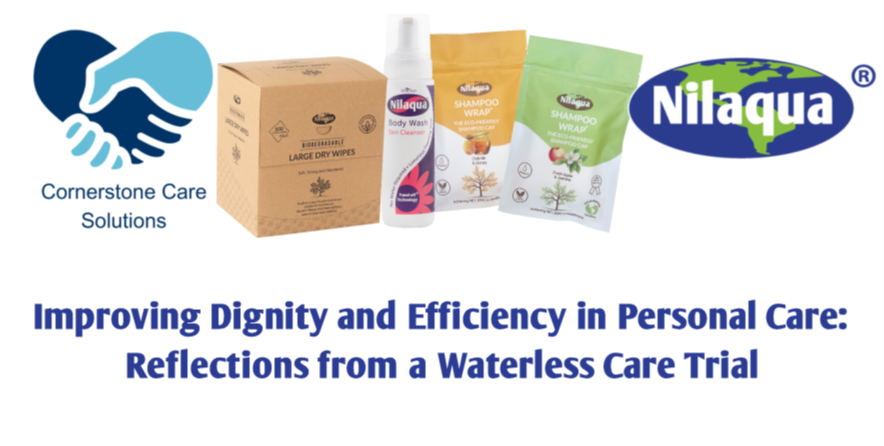

Cornerstone Care Solutions is a UK-based specialist care consultancy and turnaround services provider that works with adult social care organisations and related services to improve operational performance, compliance and sustainability. Cornerstone recognised the value of research to enhance the delivery of care and recently supported the introduction of Nilaqua waterless personal care products in one of its nursing homes.
The trial lasted 4 weeks and the aim was to assess whether waterless methods, such as no-rinse shampoo caps, body wash foams, and soft dry wipes, could offer a more dignified and efficient alternative to traditional bathing, particularly for residents who found conventional care distressing or difficult to tolerate.
This article, written by Cornerstone provides an overview of the project rationale and presents three anonymised case studies, each reflecting different clinical scenarios. Cornerstone offer practical reflections on the observed outcomes and addresses the guidance and considerations undertaken prior to commencing the trial, and offer key insights and learning and a positive conclusion to support those considering an alternative approach to more traditional personal care methods for those in receipt of personal care.
Introduction
Delivering dignified personal care is one of the most essential responsibilities in adult social care. Under CQC’s Regulation 10, all care must be delivered with dignity and respect at its core (CQC, Fundamental Standards).
Yet for many residents, particularly those living with dementia, frailty, or complex physical conditions, bathing can become a source of distress,
discomfort, or risk. As providers navigate growing acuity levels, staffing pressures, and ongoing infection control responsibilities, it’s increasingly important to explore flexible, person-centred approaches that preserve hygiene standards while supporting wellbeing.
Why Consider Waterless Personal Care?
While traditional bathing routines are appropriate for many residents, they can become problematic.
NICE guidance on dementia care advises that where bathing causes distress, staff should consider alternative approaches that reduce anxiety and support person-led routines (NICE NG97, Dementia: assessment, management and support, 2018).
Providers should consider alternative options for personal care when individuals:
- Experience cognitive impairment that causes fear or confusion around water
- Have physical conditions that make repositioning painful or unsafe
- Are at risk of skin damage or infection from excess moisture
- Require full care support, and where manual handling is a challenge
- Find the sensory or emotional experience of bathing distressing
Waterless personal care products offer an alternative. Products trialled included:
- Nilaqua Body Wash Foam: applied to the skin and towelled off without water
- Nilaqua Hair Wash Cap: warmed and massaged into the hair, no rinsing required
- Soft Biodegradable Dry Wipes: offering a sustainable alternative to standard wipes and can be used with the foam for gentle, effective cleansing
Case Study Summaries
Resident AW: Advanced Dementia and Limb Contractures
Profile: AW, aged 72, had Lewy body dementia and Parkinson’s disease. She had severe limb contractures, was non-verbal, and frequently became visibly distressed during personal care, particularly when traditional dry wipes or water-based washing were used.
Intervention: Staff trialled the Nilaqua Body Wash Foam and Hair Wash Cap, using warm, dry wipes to gently cleanse the skin in sections.
Outcomes:
- Verbal agitation and visible signs of distress reduced significantly
- Care time reduced by 10–15 minutes per episode
- Fewer repositioning movements were needed, easing handling pressure
- Staff noted greater calmness, and care could be completed without escalation
- Family members reported AW appeared “much calmer and more comfortable” after care
This case highlighted the benefits of reduced friction and minimal handling when supporting someone with complex neurological and musculoskeletal needs.
Resident BL: Frailty, Skin Sensitivity and Verbal Feedback
Profile: BL, aged 91, required full care support and had Alzheimer’s disease, heart disease, and delicate skin. He reported mild discomfort and had previously said that traditional dry wipes felt “scratchy” and uncomfortable.
Intervention: Staff introduced Nilaqua biodegradable dry wipes into daily hygiene routines, replacing the standard wipes.
Outcomes:
- BL commented positively on the feel of the wipes, calling them “soft” and “pleasant”
- Staff observed less facial grimacing and increased verbal engagement during care
- Fewer wipes were needed due to improved absorbency
- Care time reduced by approximately two minutes per episode
- Skin integrity was maintained, with no increase in soreness or irritation
This case demonstrated how small changes in product texture and quality can improve comfort and communication, even when cognitive function fluctuates.
Resident VN: Non-Weight Bearing and Distress During Care
Profile: VN, aged 87, was non-weight bearing and required hoist transfers. She lived with dementia, COPD, diabetes, and had a recent history of
infection and soft tissue damage. Personal care often resulted in agitation, vocal distress, and physical resistance.
Intervention: The team introduced the Nilaqua Body Wash Foam, applied directly to the skin and then wiped off with soft dry wipes.
Outcomes:
- Physical resistance (pushing or scratching) reduced noticeably
- Verbal distress was less frequent, and care could be completed without rushing
- Staff described the foam as easier to apply and less cold than traditional methods
- Full body washes took 10–15 minutes less time
- Hygiene standards were maintained between full baths, with reduced discomfort
VN’s case demonstrated that waterless cleansing methods can support palliative or high-dependency care without compromising dignity or hygiene.
Key Themes and Learning Points
Across all three case studies, several consistent outcomes were observed.
1. Reduced Distress and Resistance to Care
All three residents showed fewer signs of agitation or discomfort when waterless methods were used. Whether verbal or non-verbal, there was a clear reduction in negative reactions, from facial expressions to defensive behaviours. For people living with dementia, this can have a major impact on daily quality of life and staff-resident relationships.
2. Improved Dignity and Comfort
By minimising the need for full undressing, repositioning, or exposure to cold water, staff were able to deliver care in a gentler, more private manner. Residents remained covered throughout and could stay in bed or in a favourite chair, reducing feelings of vulnerability and enhancing comfort.
3. Efficiency and Reduced Physical Strain
Care episodes were consistently shorter, with time saved ranging from 2 to 15 minutes depending on complexity. This was particularly noticeable in full-body care. For staff, the reduction in manual handling and preparation time made
routines more manageable, especially during morning peaks or when staff numbers were lower.
4. Skin Integrity and Infection Prevention
Trials in NHS hospital settings have shown that waterless cleansing can maintain or improve skin integrity, reduce microbial load, and save nursing time (Vernon et al., 2018, Journal of Hospital Infection).
No decline in hygiene standards was observed during the trial period. Products were used in accordance with guidance, and no issues with skin breakdown, odour, or infection were observed. In some cases, skin condition improved due to reduced friction or exposure to harsh soaps. Maintaining skin integrity is essential to overall patient health and wellbeing. Inadequate or inappropriate skin care can result in skin breakdown, increased risk of infection, delayed wound healing, and higher healthcare costs. The use of gentle, skin-kind formulations, such as Nilaqua, plays an important role in supporting skin integrity and reducing these risks.
Water-based bed baths also carry infection risks. The Department of Health (2015) and Infection Prevention Society both recommend single-use items where possible to reduce cross-contamination.
Infection risks associated with shared water basins or reusable cloths were also avoided. It is noted that Nilaqua has “name” places on their products to help avoid cross contamination.
5. Sustainability
In light of the UK government’s planned ban on plastic-containing wet wipes, biodegradable alternatives are becoming more important for environmentally responsible care delivery (Defra, 2023).
The introduction of biodegradable dry wipes offered environmental benefits, particularly when compared with standard wipes that may contain plastic. Similarly, Nilaqua shampoo caps are biodegradable, eliminating the need for single-use plastic and supporting more sustainable hygiene practices. The CQC is another body concerned with sustainability. Regulation 17 asks how providers are adapting to climate change? This is not just non-biodegradable to biodegradable, but understanding their carbon footprint and acting to reduce it.
It’s going to become ever more important to reduce any adverse impact on the environment whilst also ensuring services are able to respond to environmental changes including impact on people’s health and operational service delivery. The trial demonstrates the benefits of a UK-manufactured
product with low CO₂ emissions, significantly reduced plastic content, lower water usage, and decreased reliance on towels and flannels, resulting in reduced laundry demands.
Considerations for Providers
Appropriate Use
Waterless personal care is not a wholesale replacement for traditional bathing. It should be considered an additional tool for:
- Residents who find bathing distressing
- People at high risk of skin damage
- Those with limited mobility or who are non-weight bearing
- Times when full bathing is not feasible (e.g., staff shortages or during outbreaks)
Staff Training
Successful use depends on proper technique. Staff should be trained to apply the foam gently, wipe without rubbing, and ensure thorough drying. Demonstrations during induction or refresher training are helpful.
Communication with Families
Families may initially have questions. Sharing the rationale, improving comfort, maintaining dignity, and reducing risk help build understanding. Feedback from families in the trial was consistently positive once outcomes were explained.
Care Planning
Waterless care should be documented in care plans, with clear rationales based on resident needs or preferences. Consent or best-interest decisions should be recorded, especially where residents lack capacity.
Conclusion
This small-scale trial of Nilaqua waterless personal care products delivered meaningful improvements in resident comfort, staff efficiency, and care quality. For residents with dementia, frailty, or reduced tolerance for traditional bathing, waterless methods offered a gentler, less intrusive alternative that preserved dignity while maintaining hygiene standards.
While not suitable for every individual or situation, waterless care has a clear role within a flexible, person-centred approach. Evidence from practice suggests it can reduce distress, save time, and ease manual handling pressures, without compromising infection prevention or skin integrity.
As care settings continue to evolve, solutions that balance practicality with compassion will become increasingly valuable. Waterless personal care is one such option, and based on this trial, it’s an approach worth exploring further.
References:
CQC (2021). Fundamental Standards – Regulation 10: Dignity and Respect.
NICE (2018). Dementia: assessment, management and support for people living with dementia and their carers (NG97).
Department of Health (2015). Health and Social Care Act 2008: Code of Practice on the prevention and control of infections.
Vernon, M.O. et al. (2018). “The impact of waterless bed baths on nursing time and skin condition.” Journal of Hospital Infection.
DEFRA (2023). Consultation outcome: Banning wet wipes containing plastic in England. UK Government.
Care Quality Commission (CQC) (2021) Regulation 17: Good governance. (Accessed: 12.02.2026). Available at: https://www.cqc.org.uk/guidance-regulation/providers/regulations-service-providers-and-managers/health-social-care-act/regulation-17

Comments
Login/Register to leave a comment