

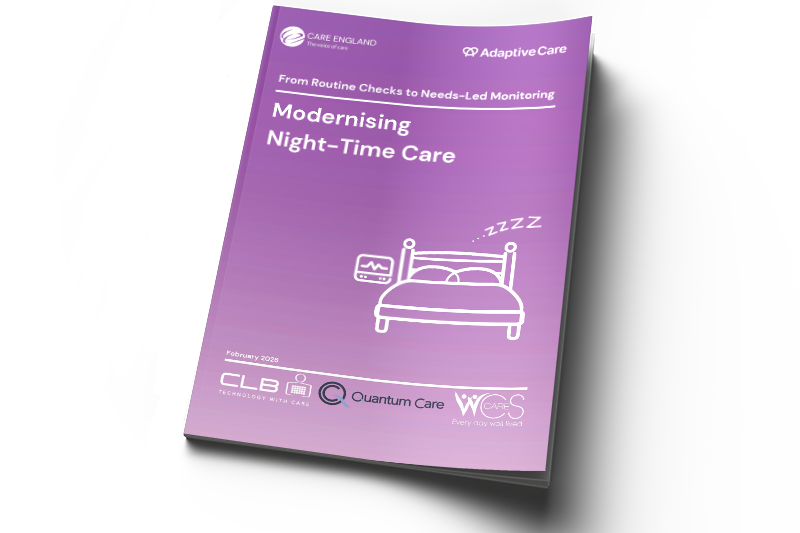


Care England has launched a landmark report, From Routine Checks to Needs-Led Monitoring, setting out a clear case for transforming night-time care across England.
Download the report

The report, developed in partnership with Adaptive Care, presents real-world evidence from leading providers including Quantum Care and WCS Care, demonstrating how traditional hourly night checks can be replaced with continuous, needs-led monitoring that delivers measurable improvements in safety, efficiency and resident wellbeing.
At the heart of the findings is one of the sector’s most persistent challenges: falls. Evidence from providers shows that modern monitoring approaches can significantly reduce both the number of falls and the escalation of incidents, reporting a 74.5% falls reduction, of which 64.5% being true falls and 9% being incidents thought to have been a fall that led to a 999 call out.
This is not simply a care home improvement; it has direct system-wide impact. In one home alone, 44 paramedic callouts were avoided over three months, reducing pressure on emergency services and delivering tangible savings to the NHS.
For decades, overnight care has relied on routine hourly checks, a model that is increasingly misaligned with modern expectations of dignity, safety and person-centred care. These checks interrupt sleep, place pressure on already stretched workforces, and provide only intermittent reassurance.
This report shows there is a better way. Across six Quantum Care homes, nearly 94,000 physical night checks and over 8,000 staff hours were required over a three-month period under traditional models. Following the introduction of acoustic monitoring, routine room entries reduced by 90%, while more than 900,000 virtual checks were carried out without disturbing residents.
The result is a fundamental shift in how care is delivered overnight, from reacting to schedules to responding to genuine need. Residents experience calmer nights and better sleep. Staff are able to focus on meaningful care rather than routine tasks, and providers gain continuous oversight that strengthens safeguarding and supports better decision-making.
Conclusion
This is more than a report. It is a blueprint for safer nights, fewer falls, and a more sustainable future for care. Modernising night-time care represents a fundamental shift from scheduled surveillance to responsive, needs-led care. By combining technology with human judgement, providers can deliver better outcomes for residents, improve staff experience, and align with the future direction of adult social care.
See the technology in action:
To support those providing or commissioning care in understanding what best-in-class implementation looks like, Care England is offering tours to review the technology underpinning the system, widely recognised as being 10–15 years ahead of the UK in adopting care technology, risk-based approaches, and centralised monitoring models.
The visit for senior leaders provides access to leading Dutch providers, operational monitoring hubs, and the innovators behind the platform, offering practical insights into scaling, workforce transformation, and improving outcomes through needs-led care. Interested parties should contact: tours@adaptivecare.co.uk.

Comments
Login/Register to leave a comment