

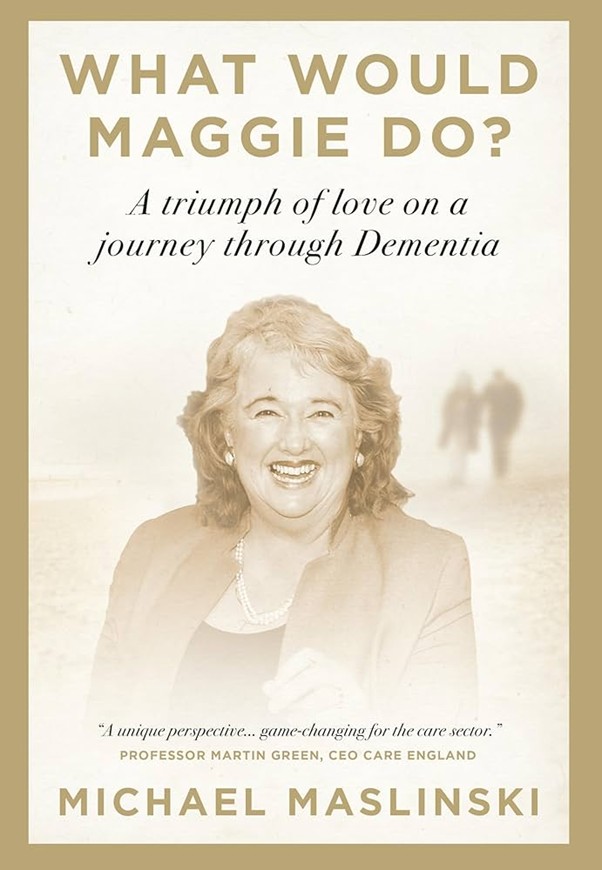

There are many books written about social care. Some focus on policy. Others on funding. Many attempt to explain the challenges facing the sector.
Very few, however, truly capture what it feels like to live inside a care service.
What Would Maggie Do? by Michael Maslinski is one of those rare books.
It is not simply a story about dementia. It is not a critique of care homes. Nor is it a technical guide to improving care. Instead, it is something far more powerful, a deeply personal, lived account of love, advocacy, and the reality of navigating the care system from the inside.
This is a book that does not just inform. It changes perspective.
A story that begins with love, and stays there
At its heart, this is a love story.
Michael’s wife, Maggie, was a formidable, intelligent and vibrant woman whose life was profoundly altered by dementia. What followed was not just a gradual decline, but a complete reshaping of their relationship, their lives, and their understanding of care.
What makes this story extraordinary is the decision Michael took.
Rather than placing Maggie in a care home and visiting, he moved in with her, living alongside her for nine years, four nights a week, while continuing to work. This gave him a vantage point that very few people will ever have, that of a husband, an advocate, and a daily observer of care in practice.
As outlined in the book, this experience is widely regarded as unique within the sector.
It is this perspective that makes the book so important.
Seeing care through the eyes of those who live it
For care providers, regulators, and policymakers, much of what we understand about the sector comes through systems, frameworks and data. This book strips all of that away.
It places the reader in the position of someone who:
- must advocate for a loved one every single day
- must interpret decisions made by professionals
- must navigate risk, regulation, and clinical judgement
- must balance safety with quality of life
And, critically, someone who must do all of this while experiencing the emotional weight of watching a loved one decline.
Michael describes not just the care that was delivered, but how decisions felt, how they were understood, questioned, and sometimes challenged.
He writes candidly about moments where:
- systems worked well and staff went above and beyond
- processes constrained good judgement
- risk aversion overrode individualised care
- families felt excluded from decisions, even when they knew the person best
This is not criticism for its own sake. It is insight.
A rare and vital perspective for providers
Professor Martin Green OBE, CEO or Care England captures the significance of this perspective perfectly in his foreword:
“This book is a must read for everybody working in residential care because it offers a unique perspective by somebody who lived in a care home to support his wife. The insights and experiences contained in this book are game-changing for the care sector.”
That statement is not made lightly. What makes this book so important for care operators is that it provides something the sector often struggles to access: authentic, continuous, real-time feedback from someone living inside the system. It is not a survey, it is not a complaint, it is not a one-off experience. It is nine years of invaluable lived experience, the uncomfortable truths we need to hear. One of the most powerful aspects of What Would Maggie Do? is its honesty.
The book acknowledges the dedication, kindness, and professionalism of care staff. It is clear throughout that the care Maggie received was, in many respects, compassionate and high quality. But it also highlights a series of tensions that will feel very familiar to those working in the sector:
- The balance between risk management and quality of life
- The challenge of personalising care within rigid systems
- The unintended consequences of regulation and compliance culture
- The difficulty of truly involving families in decision-making
Michael describes how decisions were sometimes shaped not purely by what was best for Maggie, but by:
- fear of regulatory consequences
- adherence to standardised procedures
- institutional norms
These are not criticisms of individuals. They are reflections of a system. And that is precisely why this book matters.
Why this matters now more than ever
The social care sector is under intense pressure. Debate continues to focus heavily on funding, workforce and reform. These are critical issues, but they are only part of the picture. What this book reminds us, is that the experience of care is shaped not just by resources, but by culture, judgement and human interaction. It challenges us to ask:
- Are we truly delivering person-centred care, or are we constrained by systems that make it difficult to do so?
- Do we empower staff to use judgement, or do we inadvertently discourage it?
- Are families’ partners in care, or are they sometimes treated as external to it?
These are not easy questions. But they are necessary ones.
A guide without being a guide
Importantly, this is not a prescriptive book. It does not present itself as a manual or a set of instructions. Instead, it offers something more valuable, reflection. Through Michael’s experiences, readers are invited to:
- consider how their own services operate
- reflect on how decisions are made
- think about how care is experienced, not just delivered
The book also includes practical observations and suggestions for change, drawn directly from lived experience. These are grounded, realistic, and rooted in a deep understanding of both care and organisational systems.
The voice of the family, and why it matters
One of the strongest themes throughout the book is advocacy. Michael acted not just as Maggie’s husband, but as her voice, particularly as her ability to communicate declined. This raises a fundamental point for providers, families are not just visitors, they are partners in care. Yet the book highlights how, at times, even informed and capable relatives can feel:
- overlooked
- excluded
- or secondary to professional decision-making
For care operators, this is a powerful reminder of the importance of:
- genuine co-production
- clear communication
- and respect for the knowledge families hold
A book that stays with you
This is not a book that you read and move on from. It stays with you. It stays with you because:
- it is deeply human
- it is honest
- and it reflects realities that many in the sector will recognise, but rarely see articulated so clearly
It is also, ultimately, hopeful. Despite the challenges described, the book is full of examples of:
- kindness
- dedication
- and the profound impact that good care can have
It recognises the incredible work being done across the sector, while also calling for thoughtful, meaningful improvement.
Why every care operator should read this
For those leading, managing or delivering care, this book is essential reading. Not because it provides all the answers. But because it helps you see your service through a different lens. It enables you to:
- understand how care decisions are experienced
- reflect on how your service balances risk and individuality
- consider how you engage with families
- and ultimately, think about what truly matters to the people you support
In short, it helps answer the question at the heart of the book, what would Maggie do? Or perhaps more importantly, what would the person you are caring for want, if they could tell you?
What Would Maggie Do? by Michael Maslinski is available below:
Click here to order
This book is not just about dementia. It is not just about one couple’s journey. It is about the care system we have, the care system we want, and the space between the two. For anyone working in social care, it offers something invaluable, the opportunity to see, feel, and understand care from the inside. And that is why it is a must read.


Comments
Login/Register to leave a comment