


In today’s adult social care environment, preparing effectively for Care Quality Commission inspections is no longer optional. Regulatory scrutiny has intensified, expectations have evolved, and providers are operating under increasing complexity and pressure. Many organisations now look to external consultants to support mock inspections and quality assurance. That shift, however, raises an important question for the sector: how can providers be confident that the support they commission is credible, consistent and aligned with regulatory reality.
Mock inspections have been used in social care for many years. At their best, they offer insight, challenge and a clearer understanding of how a service may be experienced by inspectors, residents and families. At their worst, they can offer false reassurance, inconsistent advice or approaches that bear little resemblance to how the regulator operates. Providers frequently tell me that they value external perspective, but struggle to judge the quality of what they are buying.
This is not a criticism of consultants themselves. Many are highly experienced former practitioners, inspectors or leaders who bring real value to the sector. The issue is structural. There has historically been no shared benchmark for what constitutes a competent care consultant, no common framework for quality, and no consistent way for providers to distinguish between varying levels of experience and approach.
That gap is increasingly significant as reliance on external support grows.
What good mock inspections should offer
A meaningful mock inspection is not a tick box exercise. It should reflect how services are experienced and how they would be assessed under the CQC framework. That means it should be rooted in observation of practice, conversations with staff and people who use services, review of evidence and governance arrangements, and an understanding of how culture, leadership and outcomes connect.
Most importantly, it should offer insight that helps services improve, not simply reassurance that everything is fine. Providers benefit most when mock inspections highlight blind spots, challenge assumptions and provide a realistic picture of strengths and risks.
The value of any mock inspection therefore rests almost entirely on the credibility of the person conducting it. If the consultant lacks current regulatory understanding, applies their own personal standards rather than the regulator’s framework, or cannot articulate findings in a way that mirrors inspection language, the exercise can mislead rather than support.
The challenge for providers
Many providers now operate in an environment where they feel they need external expertise to navigate inspections, governance requirements and increasing complexity. Yet choosing a consultant is often based on recommendation, reputation or marketing rather than on any consistent measure of competence. That places providers in a difficult position. They are expected to demonstrate strong governance and oversight yet are commissioning support in a market that itself has very little structure.
This is where the wider conversation about professionalising consultancy in social care becomes relevant. As a sector, we have invested heavily in professional standards for registered managers, nurses, social workers and other roles. Consultancy has developed rapidly, but without equivalent shared expectations around training, ethics, competence or accountability.
Accreditation as a developing idea
One response to this challenge has been the development of an accreditation framework that introduces more consistency into the consultancy landscape. The Care Consultant Accreditation Framework, or C-CAF, emerged from recognition that providers want greater confidence in the consultants they commission and that consultants themselves want clearer professional recognition.
C-CAF seeks to offer a structured way of assessing consultants against agreed criteria, including experience, understanding of regulation, safeguarding practice, and professional conduct. It is relatively new and will inevitably evolve, but it reflects a vital broader issue the sector needs to engage with: how we ensure that those offering professional advice to care providers are themselves operating within robust professional standards.
Whether through C-CAF or other approaches, the underlying principle matters. Providers should be able to commission external support with greater transparency, and consultants should be able to demonstrate credibility beyond personal marketing claims.
The importance of evidence-based reporting
I interviewed Luke Rothwell, the creator of C-CAF, and a theme that emerged strongly in the interview accompanying this article was the importance of how mock inspection findings are presented. A useful report is not simply descriptive. It should link observations to regulatory expectations, identify priorities clearly, and support leaders to make informed decisions. It should also be something that boards and senior leadership teams can rely upon when considering risk, improvement and assurance.
Some providers describe using their mock inspection reports as part of governance discussions or as evidence of proactive quality assurance. That can only work if the report itself is grounded in sound methodology and credible judgement. Again, this comes back to the competence and approach of the person producing it.
A wider conversation for the sector
This is not ultimately about one framework, one organisation or one approach. It is about a wider question the sector needs to consider seriously. As reliance on consultancy increases, how do we protect providers from poor advice, protect residents from the consequences of weak practice, and support a professional consultancy market to develop with integrity.
Providers deserve access to high quality external challenge and support. Consultants deserve recognition for expertise when it is genuine. And the sector benefits when standards are clearer and expectations more consistent.
The interview that sits alongside this article explored many of these themes in more detail for one such solution, including the lived experience of providers commissioning support, the frustrations when consultancy fails to add value, and the potential benefits when it is done well. It is a conversation worth continuing.
Conclusion
Mock inspections and external consultancy can play an important role in strengthening quality, governance and confidence across adult social care. But their value depends on credibility, consistency and integrity. As the sector continues to evolve, we should be asking harder questions about how consultancy is defined, how quality is assessed, and how providers can make informed choices about the support they commission.
Professionalising this space is not about endorsing any solution. It is about recognising that the current informal marketplace carries risks, and that developing clearer standards will ultimately serve providers, the workforce and the people who rely on care services.
Professor Martin Green OBE
Chief Executive, Care England
Watch a short interview with Professor Martin Green, OBE, and Luke Rothwell. Managing Director, C-CAF. View here.
Join our webinar!
 Readers who wish to explore these issues further are invited to register for the upcoming webinar on Tuesday 5th May.
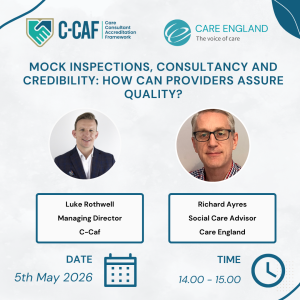 Readers who wish to explore these issues further are invited to register for the upcoming webinar on Tuesday 5th May.
The session will offer the opportunity to hear from Luke Rothwell, who co-developed the C-CAF framework, as he reflects on the risks providers face when appointing care consultants and outlines how structured approaches can help address those challenges.
Attendees will also be able to ask questions about how providers can better assure themselves that the consultancy support they commission is credible, consistent and aligned with regulatory expectations.


Comments
Login/Register to leave a comment