


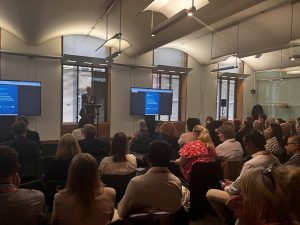
Care England today launched its good practice guide on preventing choking deaths amongst people with learning disabilities in Parliament to a crowd of sector leaders, people with lived experience and stakeholders from organisations such as the CQC.
The event was hosted by MP Greg Stafford, who represents Farnham and Borden and is a member of the Health and Social Care Select Committee of the House of Commons. Mr Stafford highlighted the merits of the report as a tool to help providers deliver safe and personalised care that treats people with dignity, rather than seeing meal times as care tasks to complete. He stated he would be sharing the report with the shadow health team of the Conservative frontbench, along with raising it with the Secretary of State for Health and Social Care in due course.
Care England’s Chief Executive, Professor Martin Green OBE, then spoke to pay tribute to the team that put the report together (pictured), led by Peter Kinsey, who chairs Care England’s Working Age Adult Special Interest Group. Thanks were also given to the CQC for their involvement and help to ensure the guide aligned with regulations, and Anthony Collins Solicitors for sponsoring the event.
Professor Martin Green said:
“What we tried to do with this guide is make it rooted in the realities and rooted in practice. We wanted something that was easy to use, and that would be recognised as a step-by-step approach, which will hopefully reduce the number of choking related deaths.”
Rebecca Bauers and Chris Badger from the CQC were also present, with the CQC having been involved in the production of the report. Rebecca addressed the attendees, highlighting another key point of the report on promoting open cultures within care services and that choking prevention is a shared responsibility between care providers, staff, families and the regulator.
Rebecca continued:
“This guidence is very much a programme of preventative measures and a proactive approach that we would really want to see.
The audience then heard from those with lived experience, including Darren Lane and Gary, who read out a reflection from Phil Hughes from Learning Disability England:
“This guide is so important to help care workers keep people like myself safe while being supported with meals. […] It is also important as the guide helps our staff have up-to-date information and traning to keep meal times safe for people like me. I also want to say that we need to do all we can to attract the right people into adult social care and give them the support they need to do their jobs well and stay in their roles.”
Emma Reeve demonstrated the practical toolkit that accompanies the report to attendees, while Tim Coolican from Anthony Collins rounded off the speeches from the event:
“I have to say the tooklit itself is important. Good guidance, practical checklists and care resources can’t make people make better decisions or provide safer care, but they provide something tangible that services and providers up and down the country can use everyday. One of the most important things that keep people safe is the culture that sits behind them. A culture where people remain curious, speak up when they have concerns, learning from one another, and for me that’s what this project really represents. It show’s organisations coming together, sharing knowlegde and experience and asking what we can do collectively to reduce risks.
It’s no surprise to see Care England, and particularly Peter Kinsey leading work of this kind. While I can think of many examples, it reminds me of the work of Care England’s Working Age Adult group during the pandemic, at a time when providers were facing unprecedented challenges and official guidence was changed rapidly. Care England’s members came together to share practical solutions, support one another and help to fill the gaps and use that knowledge to influence more relavent and effective guidence.”
The report and toolkit resources are available to read by clicking here.


Comments
Login/Register to leave a comment