

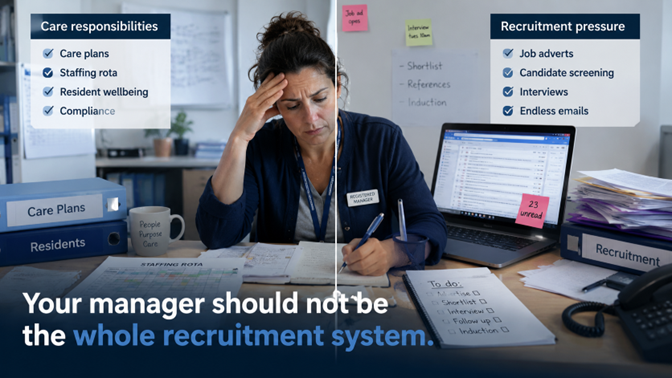


Registered Managers are central to the running of care services. They hold responsibility for quality, safety, staffing, culture, family communication, supervision, daily problem-solving and the countless small decisions that keep a service stable. Yet in many smaller groups and SME providers which make up 70% of the adult social care sector, they are also expected to act as the recruitment department.
That expectation is often unfair and ineffective. Recruitment is not simply posting an advert and waiting for the right person to appear. It involves writing job adverts, checking applications, screening candidates, phoning quickly, arranging interviews, managing follow-up, tracking conversion and understanding what is happening in the local labour market. Done well, it is active, structured and time-sensitive.
For a Registered Manager already carrying a demanding operational role, recruitment can become something squeezed into the gaps. Applications are reviewed between other tasks. Candidate calls are delayed. Interviews are booked late. Follow-up is inconsistent. None of this happens because managers do not care. It happens because the system often expects one person to hold too much.
The consequences are felt across the whole service. Vacancies remain open for longer. Existing staff carry more pressure. Agency use increases. Continuity is harder to maintain. Managers become more stretched, which can make recruitment even harder. It becomes a loop: vacancies create pressure, pressure slows recruitment, slow recruitment extends vacancies.
In the interview material behind this campaign, Stephen Forster of the Care Social Network describes hearing from care providers where Registered Managers were spending two or three hours a day managing Indeed during periods of recruitment. That is not a good use of senior care leadership time. It may be necessary in the short term if there is no other support, but it should not become the default model for a provider that wants consistent recruitment outcomes.
The answer is not to remove managers from recruitment entirely. Their judgement is vital. They know the service, the team, the values and the type of person likely to succeed. But their role should be focused on the points where their judgement adds most value: shaping the person specification, taking part in the right interviews, assessing cultural fit and helping ensure the candidate understands the reality of the role.
The administrative and process-heavy parts of recruitment need clearer ownership. Who writes and refreshes adverts? Who checks applications every day? Who screens all candidates against agreed criteria? Who books interviews? Who tracks no-shows and follow-up? Who reviews cost per hire? When these responsibilities are not explicit, the Registered Manager becomes the backstop for everything on top of multiple conflicting priorities which naturally divert their attention for all the right reasons.
The Care Social Networt repeatedly return to this point. Providers that improve recruitment do not simply spend more. They create a more organised process. They screen properly. They contact candidates quickly. They keep jobs visible. They arrange interviews promptly. They reduce missed opportunities. The manager is supported by a system rather than left to carry or be the system alone.
For care providers, this is not only a recruitment issue. It is a leadership and sustainability issue. If managers are constantly pulled into reactive recruitment administration, their capacity to lead the service is reduced. Supporting managers means giving them a recruitment process that works around them, not one that depends entirely on them.
 Care England’s webinar, How Speed Can Fix Your Care Recruitment Challenges, will explore explore how providers can reduce pressure on managers by improving recruitment ownership, structure and candidate engagement.
 Care England’s webinar, How Speed Can Fix Your Care Recruitment Challenges, will explore explore how providers can reduce pressure on managers by improving recruitment ownership, structure and candidate engagement.


Comments
Login/Register to leave a comment