

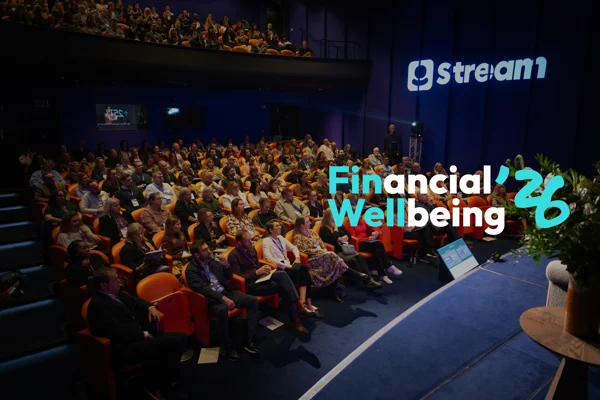

Financial pressure facing care workers is no longer a private issue that sits outside the workplace. It is a workforce issue, a retention issue, a productivity issue and, increasingly, a moral issue for a sector that depends on people already carrying significant personal and professional strain.
The Stream FinWell ’26 event, hosted by financial journalist Iona Bain, brought together employers, policymakers, financial inclusion experts and Stream’s leadership team to explore the next stage of workplace finance. The central message was clear: financial wellbeing cannot be treated as a soft benefit or something employees should resolve for themselves. Money worries follow people into work, affecting sleep, concentration, confidence, absence and morale. For adult social care, where low pay, variable hours, workforce shortages and emotional labour already intersect, this should land with particular force.
Iona framed financial wellbeing not as an abstract policy issue but as a matter of real life, noting that around one in four adults would struggle to meet an unexpected but necessary expense. Her point was not simply that people are under pressure, but that we should not allow that level of fragility to become normalised. Care workers are often asked to provide calm, compassionate, skilled support to others while managing their own instability at home. Financial stress is not left at the door of a care home or homecare round. It comes into the workplace with the person.
Stream’s founders set out a stark economic backdrop: 7.1 million UK workers are struggling with basic essentials, 23 percent of adults are locked out of the financial system, and 80 percent of UK workers cannot pass the Stanford financial literacy test. Stream’s flexible pay model was presented as a practical response — if someone has worked a shift, they should be able to access what they have earned rather than being forced into high-cost short-term credit. The payday loan market has collapsed by 90 percent since 2018, with employer-stream partnerships playing a meaningful part in that wider shift.
The platform has since developed beyond flexible pay into workplace savings, loans, pension support and financial education. Over 500,000 workers now access a weekly earnings interface; one million members have opened savings accounts with more than £400 million set aside from paycheques; and workplace loans have reportedly saved £24 million in interest. These numbers matter because they show that the workplace can be a practical route into financial resilience — and that employers hold something banks and government often struggle to build: trust.
Stream also launched its ‘W4’ platform at the event, built around personalised coaching, useful resources, and integration with the rest of the platform to understand whether interventions are working. The underlying point is that financial education delivered through generic guidance, jargon-heavy documents or one-off webinars is unlikely to help someone who is anxious, exhausted and time-poor — a description that fits many care workers.
Some of the event’s most powerful evidence came from Stream’s Chief Impact Officer Emily Trant, who talked about the “rule of 13”: that financial stress can cost the equivalent of 13 IQ points because the brain is occupied by constant money worries. Social care relies on judgement, patience, emotional regulation and relationship-based support. If financial stress reduces cognitive bandwidth, it does not just affect the individual — it risks affecting the quality of care, the experience of colleagues and the stability of teams. Impact findings showed that 76 percent of Stream users reported reduced stress contributing to increased productivity, and 74 percent reported increased hope, supporting retention.
The gender dimension is also significant. Women in the data showed greater exposure to insecure savings, debt pressure and financial shocks than male counterparts. In a sector where the workforce is disproportionately female, financial wellbeing is therefore also an equality issue.
A panel on the Government’s financial inclusion strategy reinforced these themes. Nye Coninetti of the Resolution Foundation highlighted that one in seven workers experiences monthly pay changes of up to 25 percent — a crucial point for social care, where variable hours and rota patterns are common. Conor D’Arcy of the Money and Mental Health Policy Institute noted that 300,000 people leave employment annually due to mental health challenges closely linked to financial difficulty. For care employers, every lost worker means recruitment costs, agency pressure, instability for people receiving care and additional strain on remaining staff. If financial stress contributes to people leaving, then financial wellbeing is a retention strategy.
Kate Pender of Fair4All Finance challenged the idea that financial inclusion can be neatly separated into categories, and highlighted 10.5 million people with no credit history and 6.5 million with challenging credit files. The panel was clear that the choice for employers is not between doing nothing and pushing staff into debt. It is between leaving workers to navigate high-cost, unsafe credit alone, or helping create access to safer, fairer workplace options with appropriate protections.
The practical messages from FinWell ’26 for employers were direct: increase uptake of existing benefits, help staff claim the estimated £24 billion in unclaimed government entitlements each year, revisit pension contributions that were set at induction and never reviewed, and build financial education into everyday workforce support rather than treating it as a one-off event.
For adult social care, the opportunity is clear. The sector employs hundreds of thousands of people whose work is essential, skilled and deeply human — yet too many face financial insecurity. Helping care workers understand their earnings, avoid high-cost debt, build savings, access fairer credit, find lost pensions and claim their entitlements is not peripheral to care quality. It supports the people who deliver care.
Workforce wellbeing cannot stop at mental health support, training or recognition days. It must include money. For many care workers, financial stress is not an occasional inconvenience — it is the background noise to daily life. Reducing that noise may be one of the most practical steps employers can take to help staff stay, cope and thrive.


Comments
Login/Register to leave a comment