

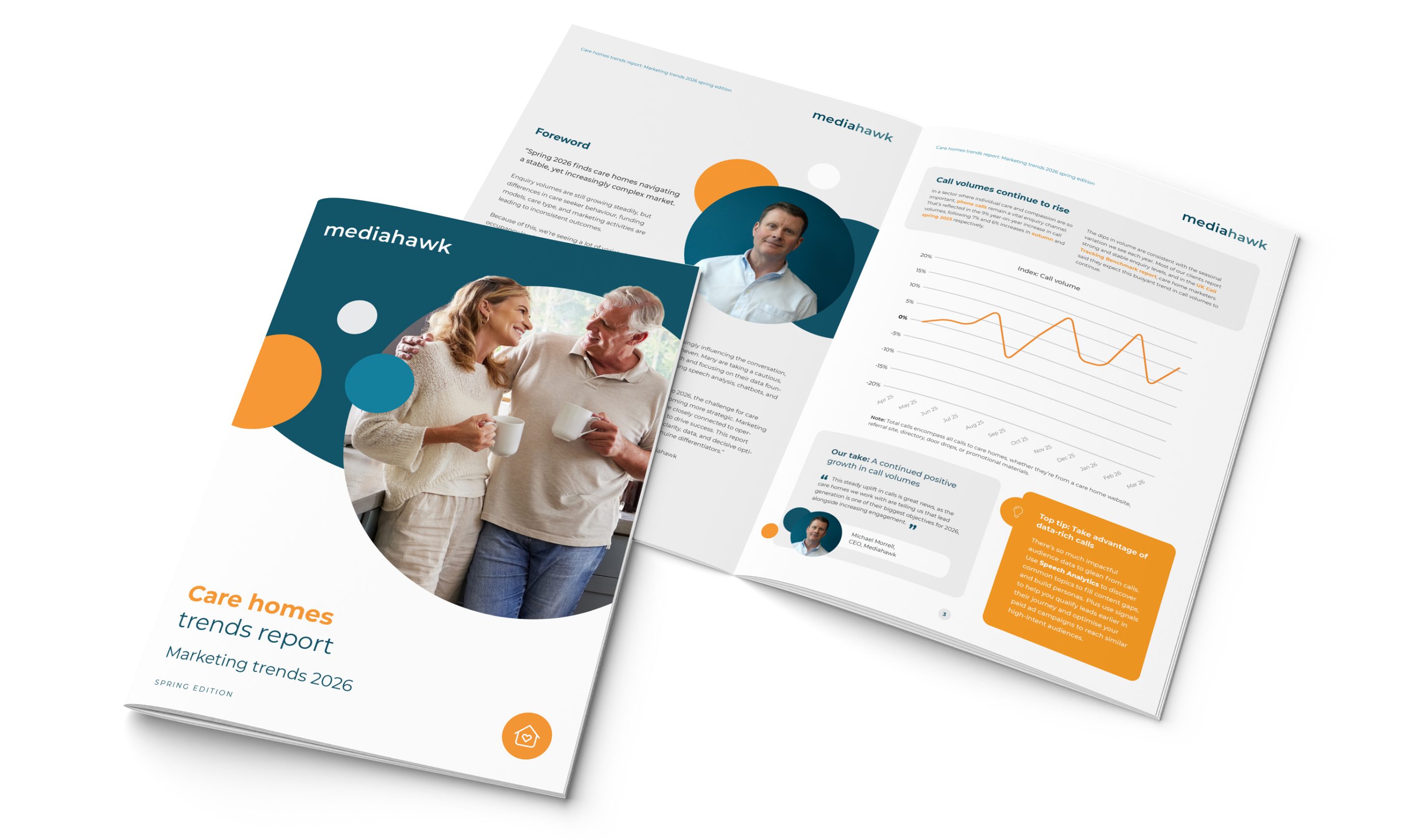


Enquiry volumes are up. Budgets are holding. So why are so many care home groups still struggling to convert interest into occupancy? Mediahawk’s spring 2026 care homes trends report points to a common culprit – and a clearer path forward.
On the surface, the picture looks encouraging. According to Mediahawk’s latest data, call volumes and website visitors both increased by 9% year on year. Marketers are holding their budgets, and many have responded smartly to the evolving search landscape by shifting spend towards pay per click (PPC) to offset the potential impact of AI-powered search engines.
But growth in enquiry volume doesn’t automatically translate to growth in occupancy. The problem isn’t always the number of people reaching out – it’s what happens to them once they do. Care seekers are taking longer to make decisions, moving between multiple channels, and arriving at enquiry with far more complex needs than a single last-click metric can capture.
For care home groups without end-to-end tracking in place, those journeys are happening just out of sight. And the cost of that blind spot is significant.
The research cycle is getting longer
One of the most telling figures in this spring’s report is the visitor-to-call ratio (VCR) – the relationship between visits to a care home’s website and calls originating from it. In spring 2026, VCR dropped by 7.5% year on year. More people are visiting before they pick up the phone.
That’s not necessarily a problem. A longer research cycle means more opportunities to build trust, answer questions, and demonstrate why your home is the right choice. But it does require your website and content to work considerably harder than they may have done in the past. Micro-conversions – a brochure download, a fee guide request, a virtual tour view – are no longer nice-to-haves. They are signals of intent, and they need to be tracked.
The care home groups that are converting at the highest rate are those that understand these moments and act on them. By pairing downloadable resources with clear calls to action, and by ensuring that every touchpoint feeds into a coherent attribution model, they can identify which interactions are genuinely moving care seekers closer to a decision.
Care seekers are telling you what they need – but are you listening?

Mediahawk’s call data reveals a nuanced pattern of behaviour that has significant implications for how care home marketers plan their campaigns. While enquiry volumes dip in summer and winter, calls driven by the ‘respite’ keyword peak during exactly those periods. The market for short-stay care is active precisely when long-term enquiries slow down.
For operators who have visibility into keyword-level call data, this is actionable intelligence. For those who don’t, it’s a missed opportunity. The same logic applies across your entire marketing mix: the care seekers most likely to convert are those whose behaviour you can read clearly enough to meet them at the right moment, with the right message.
The call itself remains the most important conversion point in the care home sector. Research consistently shows that a well-handled call – from a team member who knows where the care seeker has been and what they’ve been looking for – accelerates the decision-making process considerably. Speech analytics and call tracking tools make that level of preparation possible at scale.
Channel mix is shifting – and it’s working
The data shows care home marketers adapting with confidence to a changing channel landscape. Google PPC web traffic increased by two percentage points, while Google organic dipped by three. Bing and Facebook PPC both saw strong growth – 553% and 121% respectively – from a smaller base, but indicative of where some operators are finding incremental gains.
What’s particularly interesting is the sector’s relative resilience to AI-driven search disruption. While many industries have reported dips in organic traffic as AI overviews absorb search intent, care home enquiry volumes have continued to grow. The complexity and personal nature of care decisions appears to sustain demand for direct engagement – with websites, and with people.
That makes it all the more important that when a care seeker does reach out, the experience – and the data collected from it – is as good as it can be.
From data to decisions
The care home groups making the most of this moment aren’t necessarily those with the largest budgets. They’re the ones with the clearest picture of their marketing performance – who’s enquiring, from where, and why they convert. That clarity is what turns steady enquiry volumes into measurable occupancy growth.
The spring 2026 care homes trends report from Mediahawk sets out the full picture – including detailed analysis of enquiry trends, channel performance, and care seeker behaviour.
Download it for free at mediahawk.co.uk/care-trends.

Comments
Login/Register to leave a comment