

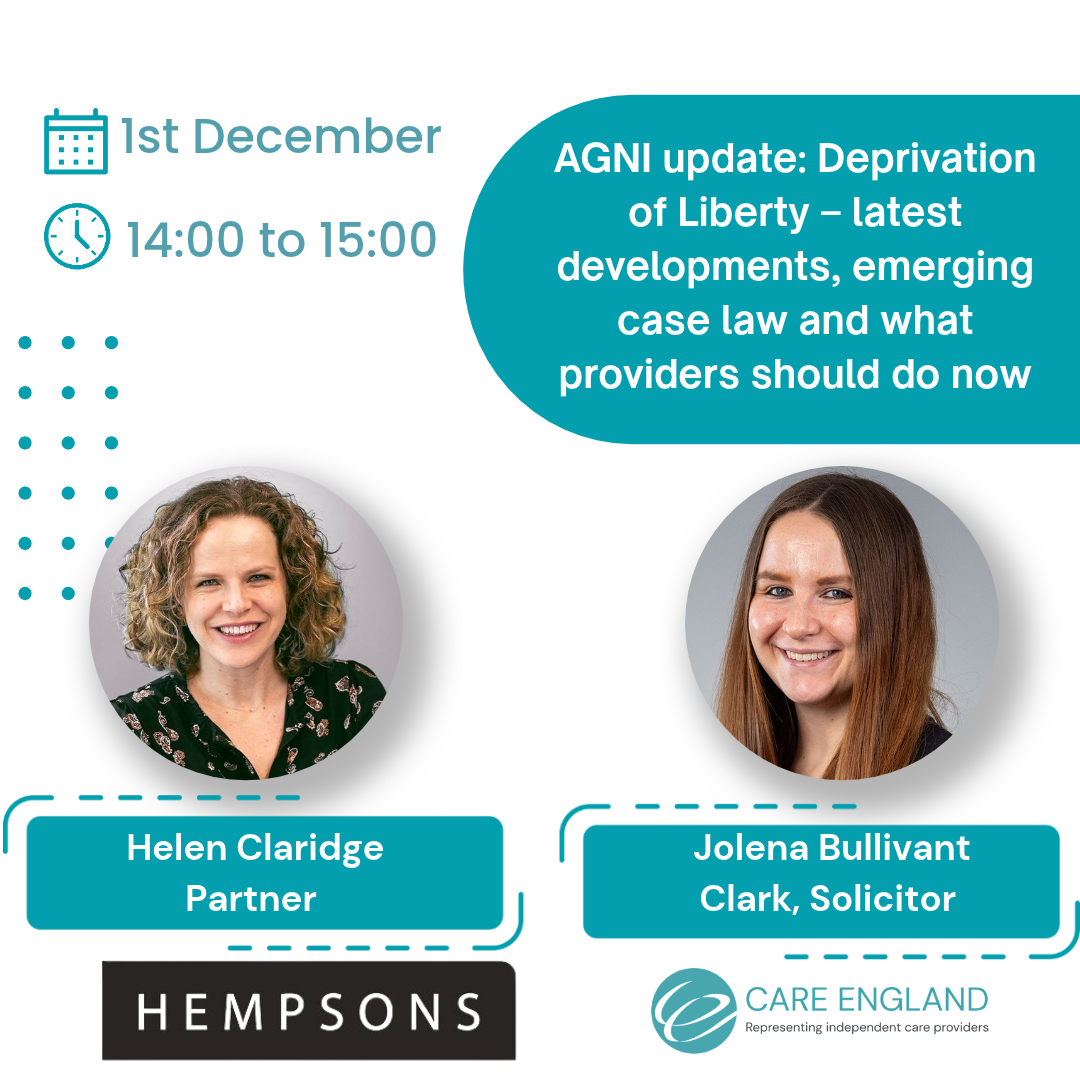

Six months on from the Supreme Court’s landmark AGNI judgment, how is the new approach to Deprivation of Liberty working in practice and what should providers be doing now?
On 2nd June 2026, the Supreme Court fundamentally changed the legal approach to determining whether a person is deprived of their liberty, overturning the long-established Cheshire West “acid test” and replacing it with a multifactorial assessment.
Care England and Hempsons held a major sector webinar in September to explain the judgment, the new legal framework and the immediate implications for providers.
Since then, providers, local authorities, commissioners, regulators and the courts have continued to work through what the judgment means in practice.
This follow-up webinar will move the discussion forward.
Helen Claridge, Partner at Hempsons, and Jolena Bullivant-Clark, Associate at Hempsons, will provide an update on the developing position, emerging case law and the practical issues providers are encountering when applying the new test.
The session will also consider the latest publicly available guidance from the Department of Health and Social Care and CQC, including any further guidance published ahead of the webinar.
What will the webinar cover?
The session will explore:
-
what has developed since Care England and Hempsons’ September AGNI webinar;
-
the latest available position on DHSC and CQC guidance;
-
emerging Court of Protection cases and what they tell us about how the multifactorial test is being applied;
-
the role of valid consent and the person’s wishes and feelings;
-
how providers should approach cases where the answer remains unclear or borderline;
-
what providers should be recording and evidencing;
-
what should happen where existing DoLS authorisations or review requests remain outstanding;
-
working with local authorities, ICBs and other commissioners;
-
the continuing importance of Mental Capacity Act, best-interests and least-restrictive-practice requirements;
-
what CQC may expect providers to demonstrate; and
-
practical actions providers should now be taking within their services.
Why attend?
The AGNI judgment has immediate effect, but its practical application continues to develop.
DHSC’s current published guidance confirms that the old Cheshire West acid test should no longer be used as the sole basis for determining deprivation of liberty. Instead, providers must look at the individual circumstances and undertake a multifactorial assessment. Further government guidance and practical case studies are also in development.
CQC has confirmed that it expects providers to continue considering each person’s circumstances on a case-by-case basis, providing person-centred care and meeting their existing Mental Capacity Act and regulatory responsibilities.
This webinar will help providers understand how those principles are translating into practice and identify where further action may now be needed.
Who should attend?
This webinar will be particularly relevant to:
-
registered managers;
-
nominated individuals;
-
operations and quality leaders;
-
safeguarding and Mental Capacity Act leads;
-
clinical and governance teams;
-
care home providers;
-
supported living providers;
-
learning disability services;
-
domiciliary care providers;
-
Shared Lives services; and
-
provider colleagues responsible for care planning, restrictions, consent and best-interests decision-making.
Speakers
Helen Claridge – Partner, Hempsons
Helen specialises in mental capacity, mental health and Court of Protection matters and regularly advises health and social care organisations on complex deprivation of liberty and best-interests issues.
Helen has been closely involved in Care England’s engagement on the implications of the AGNI judgment and the developing national guidance.
Jolena Bullivant-Clark – Associate, Hempsons
Jolena specialises in social care regulatory and advisory matters, including CQC compliance, Mental Capacity Act requirements and the practical implications of Deprivation of Liberty for providers.
Jolena also delivered Care England’s September AGNI webinar, helping providers understand how the new legal test should be approached and evidenced in practice.
Background
The Supreme Court’s judgment in A Reference by the Attorney General for Northern Ireland [2026] UKSC 16 was handed down on 2nd June 2026.
It rejected the Cheshire West approach under which continuous supervision and control and not being free to leave formed the familiar “acid test”.
The new approach requires consideration of multiple factors relating to the person’s actual circumstances. No single factor is determinative.
The judgment also clarified that valid consent for Article 5 purposes is distinct from decision-making capacity under the Mental Capacity Act, making the person’s wishes, feelings and response to their arrangements increasingly important.
The September Care England and Hempsons webinar introduced providers to this new framework. This December webinar will focus on what has happened since and what providers should do next.


Comments
Login/Register to leave a comment